
Daniel Osborne, Features Reporter.
You are standing at the bathroom mirror at 7am, foundation blended, brows done, and you reach for a can you bought on impulse because a video told you it would make your makeup last through a Bunbury summer. Half the products under your sink were bought the same way. The question you actually type into Google at midnight is simpler: does setting spray even do anything, or is it just hairspray with a prettier label?
Here is the useful fact to start with: setting spray does not stop makeup sliding off through sheer stickiness. Most formulas work by evaporating a fine film of polymer or silicone across the skin’s surface, creating a light mesh that reduces the movement of pigment and oil underneath it. That mesh is doing a mechanical job, not a magic one, and understanding that changes how you shop, how you apply it, and when you should not bother at all.
This guide walks through what setting spray is actually built from, how to use it so it earns its place in your routine, and the mistakes that quietly undo a good makeup morning.
- Setting spray works mechanically, not magically: it lays down a thin polymer film that limits movement, it does not “melt” makeup into skin or fix a bad blend.
- Distance and drying time matter more than brand: holding the can 20 to 30 centimetres away and waiting a full 60 seconds before touching your face changes the result more than which spray you bought.
- Most people only need it for humidity, long days, or photography: for an ordinary day indoors, a good moisturiser and primer routine may do the same job without an extra product.
What A Setting Spray Is Actually Made Of
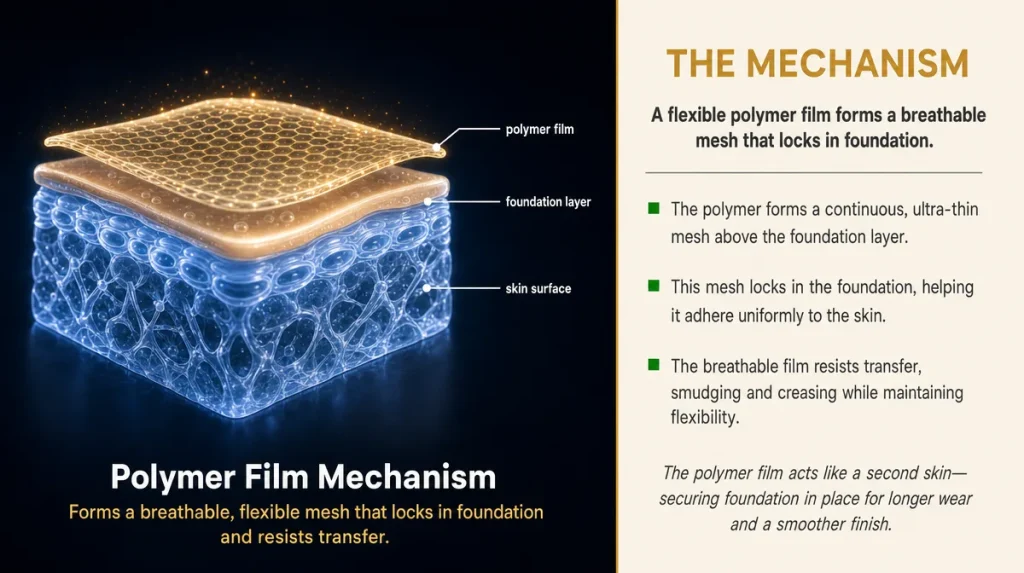
Strip back the marketing copy and most setting sprays share the same bones: water or a water-alcohol base, a film-forming polymer such as a PVP derivative, sometimes a light silicone, and a small amount of humectant to stop the finish looking papery.
Think of it like the varnish on a wooden table. The varnish does not change the wood underneath, it just seals a thin, flexible layer over the top that resists fingerprints and spills for a while. Setting spray does the same thing to a finished makeup look: it does not fix uneven blending or patchy powder, it just seals whatever is already there.
A 2021 study in the International Journal of Cosmetic Science measured transfer resistance of film-forming sprays against bare foundation and found a measurable drop in pigment transfer onto fabric after application, though the effect faded within six to eight hours depending on formula thickness. That is a useful benchmark: if a spray claims all-day wear beyond that window, treat it as marketing rather than chemistry.
Finding Out If You Even Need One
Before buying anything, run a simple self-test. Do your normal makeup on a day you plan to stay mostly indoors, skip the spray, and check your reflection at the six-hour mark. Note where it has faded: nose and chin usually go first because of oil, cheeks fade from touching and talking.
If the fade is patchy oil breakthrough, a setting spray will help only marginally. That is a job for a mattifying primer or blotting paper, not a fine mist over the top. If the fade is even, all-over dulling, a setting spray genuinely earns its place.
People who benefit most are those working long shifts under bright light, standing in humidity, or being photographed for hours, such as at a wedding. Someone doing a school run and an office day rarely needs it. Skipping it on an ordinary day is not a failure of routine, it is simply not the job the product was built for.
The 20 To 30 Centimetre Rule
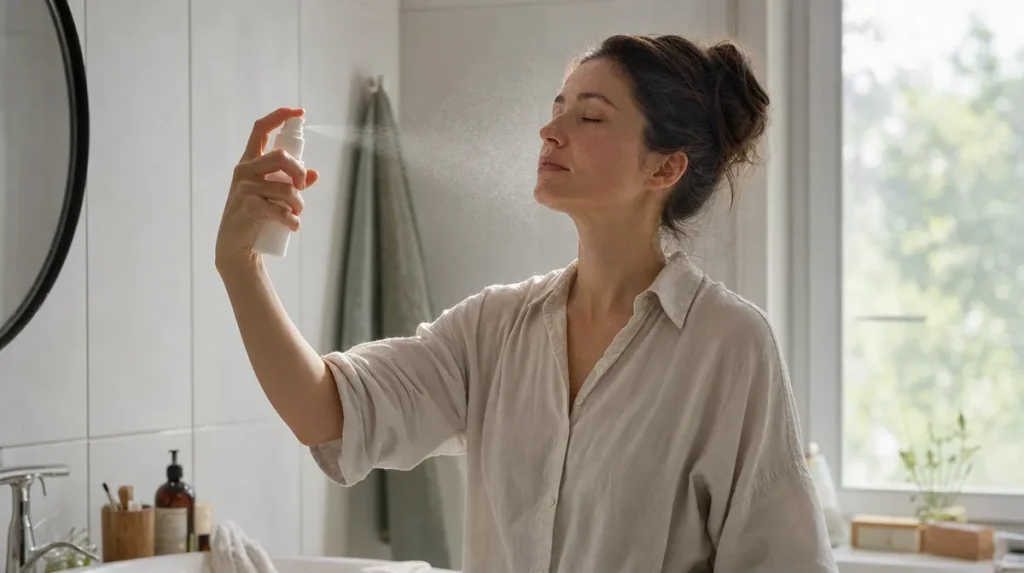
The single biggest mistake beginners make is spraying too close. At under 15 centimetres, the mist lands as visible droplets rather than a fine fog, and those droplets can smear powder products before the polymer has a chance to dry evenly.
Hold the can 20 to 30 centimetres from your face, roughly the length of a standard ruler and a bit more, and use two light passes in an X shape, then a third straight down the centre. Close your eyes and mouth, keep the nozzle moving the entire time, and resist the urge to go over any one area twice.
Then do the hardest part: nothing. Wait a full 60 seconds before touching your face, putting on sunglasses, or pulling on a jumper over your head. That waiting period is when the film actually sets. Rush it and you undo the whole exercise.
Reading A Label Without Falling For It
Ingredient lists on setting sprays are short and fairly easy to parse once you know the pattern. Near the top you are looking for a film former: names ending in “crosspolymer”, “copolymer”, or simple PVP will do the mechanical work.
Further down, humectants such as glycerin or panthenol keep the film flexible so it does not read as stiff or cakey on the skin. A small amount of alcohol denat. near the top of the list helps the product dry fast and can genuinely improve oil control, but a formula led heavily by alcohol may feel tightening on drier skin.
What you can mostly ignore: added fragrance oils, colour, and any language around “infused with” botanicals in tiny concentrations near the bottom of the list. They are unlikely to meaningfully change how the spray performs, and for sensitive or reactive skin, fragrance is worth checking regardless of what else is promised on the front label.
Matching Finish To Skin Type, Not To Trend
Setting sprays generally split into three finishes: matte, dewy, and a middle “natural” finish. The mistake is choosing based on what looks good in a video rather than what your skin actually does during the day.
Oily and combination skin usually holds up better with a matte, alcohol-forward formula because it helps manage midday shine. Dry or mature skin often looks worse with a heavy matte spray, since the flat finish can sit into fine lines and emphasise texture rather than smooth it. A dewy, glycerin-rich spray tends to sit better here.
A simple way to test this without committing to a full bottle: ask for a sample sachet or tester spritz at a pharmacy counter, apply it over bare skin on the back of your hand, and watch how it dries over two or three minutes. If it goes chalky or grey, it will likely do the same on your face.
Layering Order And Where People Go Wrong
Setting spray sits at the very end of a routine, after powder, after blush, after highlighter, never in the middle. A common mistake is spraying midway through application to “melt down” heavy powder. This can work briefly for blending harsh edges, but it also disturbs whatever comes after, since a slightly damp base does not hold new powder well.
A cleaner method: finish the entire look, including brows and any powder highlight, then apply the spray once at the very end as the final seal. If you use a setting powder as well, apply that first and let it sit for a minute before misting, so the spray is sealing a finished surface rather than fresh powder that has not settled.
If your look genuinely needs touching up through the day, carry blotting papers rather than reapplying spray over old makeup. Reapplying spray on top of hours-old product tends to reactivate oils sitting beneath it rather than freshen anything.
Judging Results Honestly
Give a new spray a fair trial across at least three separate wearing conditions before deciding it works or does not: an ordinary indoor day, a warm or humid day, and a longer twelve-hour stretch. One bad result on a 38 degree day tells you little about how a formula performs generally.
Watch specifically for transfer onto a phone screen or shirt collar, visible shine breaking through by the six-hour mark, and any tightness or flaking around the nose or forehead, which usually signals too much alcohol for your skin type rather than a fault with the spraying technique.
A 2019 consumer survey summarised by CHOICE noted that Australian shoppers frequently overestimate how long “long-wear” cosmetic claims actually hold in real humidity, a reminder that label claims are tested under controlled conditions that rarely match a Queensland afternoon. Judge the product against your own conditions, not the marketing copy.
Key Takeaways
Setting spray is a mechanical finishing step, not a fix for a poorly blended base. It works by drying into a thin, flexible film over your finished makeup, and that film resists movement rather than melting anything into place.
Most of what changes the result is technique: holding the can at the right distance, waiting for it to dry undisturbed, and applying it only once, at the very end. Choosing a finish that suits your skin type matters more than choosing a specific formula, and an honest three-condition trial will tell you more than any label promise.
A Quick Checklist Before You Buy Or Reapply
- Confirm you actually need it: humid day, long shift, or photography, rather than an ordinary day indoors
- Check the label for a film-forming ingredient near the top, not just fragrance and botanicals near the bottom
- Choose a finish (matte, dewy, natural) based on how your skin behaves by midday, not on trend
- Hold the can 20 to 30 centimetres away, two passes in an X, one down the centre
- Wait a full 60 seconds before touching your face or dressing
- Apply it once, at the very end of the whole routine, never midway through
- Judge performance over at least three different wearing conditions before deciding it works
This article is general information only and does not replace advice from a qualified dermatologist or pharmacist.
Individual skin responses vary, and results described here may not reflect every reader’s experience.