
Chloe Fenwick, Beauty Editor.
You are standing in front of the bathroom shelf again, three half-used bottles lined up like unfinished sentences. One smelled like citrus and vanished by lunch. One was lovely in the shop and cloying by the second wear. The third you bought because a friend wore it well, and on you it does something entirely different. So you type the question into Google that everyone eventually types: what actually makes an everyday perfume work, and how do you pick one without wasting another fifty dollars.
Here is the fact worth knowing before anything else: an eau de parfum typically holds 15 to 20 percent fragrance concentrate, against roughly 5 to 15 percent in an eau de toilette. That difference alone explains most of what frustrates people about longevity, and almost none of the marketing copy mentions it plainly. This guide walks through what to check before you buy, how to test a scent properly, and which claims are worth ignoring.
- Concentration, not brand reputation, predicts how long a scent lasts on your skin across a working day.
- Skin chemistry changes a fragrance more than the bottle does, which is why testing on paper alone misleads almost everyone.
- Where and how you apply matters as much as what you buy, and most people apply in ways that waste product.
Reading The Concentration Label Before You Buy
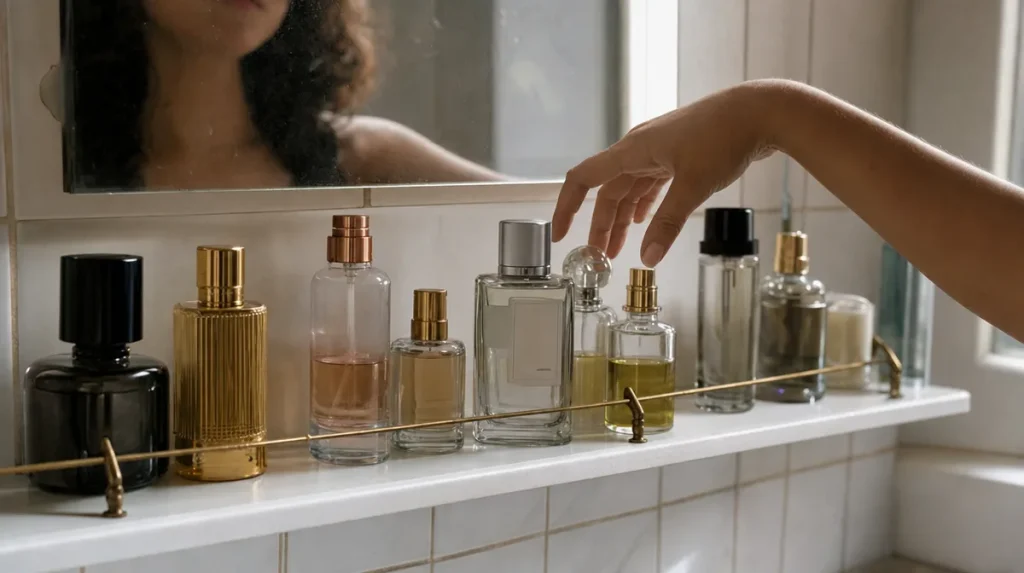
Fragrance bottles carry a concentration term somewhere on the box: parfum, eau de parfum, eau de toilette, eau de cologne. Think of it like coffee strength. A ristretto and a long black use the same beans, but the ratio of concentrate to water changes everything about how long the taste sits on your tongue.
Eau de parfum, at roughly 15 to 20 percent concentrate, generally lasts six to eight hours on skin, sometimes longer depending on the individual notes. Eau de toilette, at 5 to 15 percent, often fades within three to four hours. Neither is objectively better. An EDT suits a scent you want to be subtle, or a warmer climate where anything heavier feels overwhelming by midafternoon. An EDP suits an everyday signature you want to still register at 5pm.
The mistake most buyers make is choosing on brand or bottle design and only discovering the concentration once it fades faster than expected. Before buying, find the word on the box. If it is not there, ask the counter staff directly, and if they cannot answer, treat that as information too.
Testing On Skin, Not On Paper
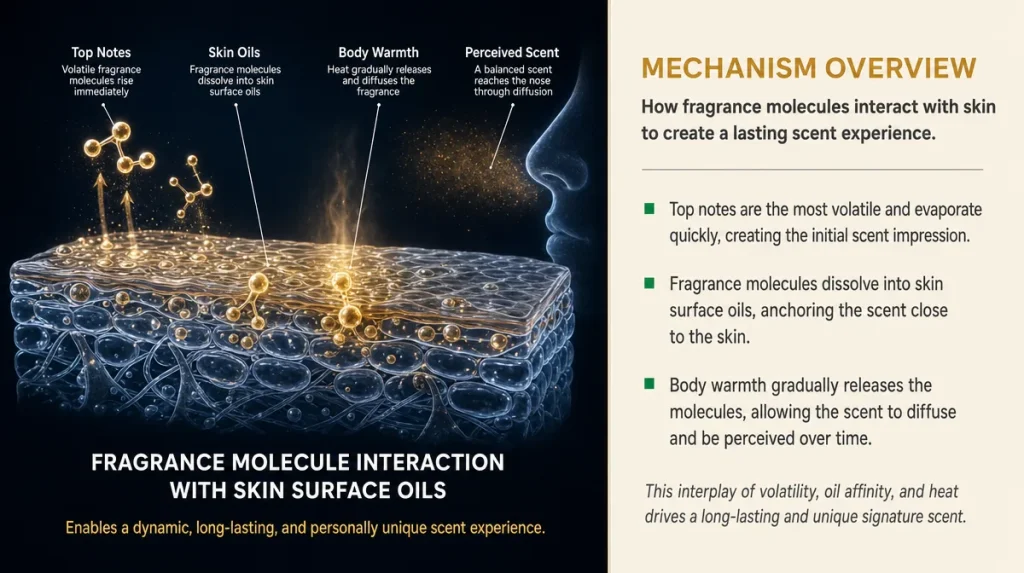
Paper test strips are useful for a first impression, nothing more. They tell you what the top notes smell like in isolation, on a surface with no oil, no warmth, no pH.
A household comparison: smelling a scent on paper is like judging a soup from the smell of the packet. The base ingredients, skin oils, body temperature, even diet, all change how a fragrance develops once it is actually worn. A 2019 study in the journal Chemical Senses found that individual skin chemistry measurably alters the perceived intensity and character of identical fragrance compounds between wearers.
The practical method: spray on the inside of your wrist or elbow, wait ten minutes for the top notes to burn off, then smell again at the one hour mark and again after three or four hours. Retailers who discourage this, or rush you toward a decision at the counter, are working against your own interest in getting this right.
A quick self-test while you read this: think of a perfume you loved on someone else and disliked on yourself. That gap is not a flaw in the fragrance. It is simply your skin chemistry reading the same molecules differently, which is precisely why testing in a shop, on your own skin, beats any recommendation from a friend or a review.
Where You Apply Changes How Long It Lasts
Most people spray once at the neck and move on. That single spray sits on skin with little to hold onto, and the neck is also an area that gets washed, brushed by hair and clothing, and exposed to weather more than most other spots.
Pulse points, the inner wrists, behind the ears, the base of the throat, carry slightly more warmth, which helps release the scent gradually rather than all at once. Some perfumers also recommend a light spray at the back of the knees or inner elbows, areas that stay warm and protected under clothing, releasing scent subtly as the day goes on.
A genuinely useful trick many people skip: apply straight after a shower, while skin is still slightly damp and pores are more receptive, rather than over dry skin at the end of a routine. Avoid rubbing wrists together after spraying. Friction breaks down the top notes faster and can shift how the fragrance develops, something perfumers have noted for years even though it remains common habit.
Do not overspray to compensate for a scent that feels weak on first application. Give it the full ten minutes before deciding it needs another layer. Fragrance almost always blooms fuller a few minutes after application than it seems in the first instant.
How Your Own Chemistry Changes A Scent
Two people can wear the identical bottle and produce noticeably different results, and this is normal rather than a sign either bottle is faulty. Skin pH, natural oil production, diet, medication and even hormonal cycles all interact with fragrance compounds.
Drier skin tends to hold fragrance less well than oilier skin, since natural oils act as a kind of anchor for scent molecules. This is one reason perfumers sometimes suggest a light, unscented moisturiser under fragrance in the colder months, giving the scent something to cling to.
The mistake here is assuming a fragrance that faded quickly on you would fade quickly on everyone, or that a scent that felt overwhelming on a friend will feel the same on your own skin. It frequently will not.
If you are shopping specifically to replace a scent you loved that has since been reformulated or discontinued, be prepared for some disappointment when comparing memory to a new bottle. Fragrance memory is notoriously unreliable, and the scent you remember loving a decade ago is coloured by the context you wore it in as much as by the notes themselves.
Layering Without Overwhelming A Room
Layering, wearing a scented body lotion or oil under a perfume, can extend longevity without needing to reapply through the day. The method works because the base layer sits closer to skin and releases more slowly, while the perfume itself carries the top and heart notes.
The common mistake is layering two strongly different scent families, a citrus body wash under a heavy amber perfume, for instance, which can create a muddled effect rather than a richer one. A simpler approach: choose an unscented or very lightly scented moisturiser as your base, and let the perfume itself do the work of character.
Office environments and shared spaces are worth thinking about separately from personal preference. A scent that reads as pleasant at arm’s length can carry much further in an air-conditioned office or a crowded lift than it does at home. If colleagues have mentioned your fragrance more than once, that is a signal to reduce quantity rather than switch entirely, since the same scent applied more sparingly often reads as more sophisticated than the same scent applied heavily.
A rough guide for everyday wear: two to three sprays for an EDP is generally sufficient for eight hours in an indoor setting. More is not automatically better, and past a certain point, additional sprays mostly increase how far the scent travels rather than how long it lasts on you specifically.
Storage: Heat And Light Are The Real Enemies
A bottle kept on a sunlit windowsill or in a steamy bathroom will degrade faster than the same bottle stored in a cool, dark drawer, sometimes losing character within months rather than years. Ultraviolet light and heat both accelerate the breakdown of fragrance compounds, altering the balance between top, heart and base notes.
Think of it the way you would think of wine kept near a stove: it does not spoil instantly, but it ages faster and less predictably than it should. Perfume behaves similarly. The original box, if you kept it, is actually a reasonably good storage container, since it blocks light entirely.
A fragrance that has visibly changed colour, particularly darkened or turned slightly syrupy, has usually oxidised, and the scent profile will likely have shifted with it. This is not dangerous, but it does mean the fragrance you smell may bear little resemblance to what you bought.
Most eau de parfums remain stable for three to five years unopened, and somewhat less once opened and exposed to air repeatedly. If a favourite scent has started smelling flatter or sharper than you remember, check the storage conditions before assuming the formula has changed.
Marketing Words That Mean Less Than They Sound
Terms like long-lasting, intense or luxury blend carry no regulated definition in the fragrance industry, and a bottle can use any of them regardless of actual concentration or ingredient quality. Consumer testing bodies, including CHOICE in its broader work assessing whether marketing language matches measurable performance, have long noted that descriptive claims on packaging rarely correspond to independently measured results across categories.
The concentration percentage and the ingredient list, where disclosed, tell you more than any adjective on the box. Natural does not automatically mean gentler either. Natural fragrance compounds, particularly citrus oils and certain florals, are among the more common triggers for skin sensitivity, a point the Australasian College of Dermatologists has raised in general public guidance on patch testing new topical products, fragrance included, on a small area of skin before regular use.
If you have sensitive skin or a history of reactions, a simple patch test on the inner forearm, left for 24 to 48 hours before applying more broadly, remains sound general advice regardless of how a product is marketed. Redness, itching or a rash means discontinuing use and, if it persists, seeking advice from a GP or dermatologist rather than assuming it will settle on its own.
Building A Small Rotation Instead Of One Signature
The idea of a single signature scent worn every day is a relatively modern marketing construct rather than a rule anyone needs to follow. A small rotation of two or three fragrances, one lighter for daytime or warmer weather, one richer for evening or winter, tends to serve most people better than committing to one bottle for years.
Rotating also protects against a phenomenon called olfactory fatigue, where your own nose stops registering a scent you wear constantly, even though others around you can still smell it clearly. This is why people sometimes overapply a long-worn signature scent without realising it. If you have worn the same perfume daily for years, it is worth asking someone close to you honestly how strong it reads to them, since your own sense of it has likely dulled.
There is no need to buy a large collection to achieve this. Two well-chosen bottles at different concentrations and character, tested properly on your own skin rather than on paper, will generally outperform a shelf of half-used impulse buys bought for the bottle rather than the wear.
Key Takeaways
Concentration on the label, not brand reputation, is the strongest predictor of how long a scent lasts through your day. Test on skin, never on paper alone, and give a fragrance ten minutes before judging it. Apply to pulse points on slightly damp skin rather than overspraying dry skin at the end of a routine. Store bottles away from heat and light to slow the natural breakdown of fragrance compounds. Treat marketing terms like long-lasting or intense as unregulated language rather than evidence, and patch test new fragrances if you have sensitive skin.
A Short Checklist Before You Buy
- Check the concentration term on the box: parfum, eau de parfum, eau de toilette
- Test on your own skin, not a paper strip, and wait at least ten minutes
- Apply to pulse points, ideally on slightly damp skin
- Avoid rubbing wrists together after spraying
- Store the bottle away from sunlight and bathroom steam
- Patch test on the inner forearm first if you have sensitive skin
- Reassess quantity if colleagues or family mention your scent often
This article is general information only and is not a substitute for individual advice from a dermatologist or GP.
Individual results and skin reactions vary, and what suits one person’s skin may not suit another’s.