
Daniel Osborne, Features Reporter.
You are standing in the shower with a bottle in each hand, the cheap one that smells like a fruit salad and foams instantly, and the expensive one a friend swore by that does neither of those things. Your skin has been tight and itchy since winter started, no matter which one you use. You type the question into your phone while the water runs: best body wash for sensitive skin, and three hundred thousand results tell you nothing useful.
Here is the fact that changes how you shop. Foam has almost nothing to do with how well a wash cleans or how gentle it is on skin. A 2019 review in the International Journal of Cosmetic Science found that foam volume is driven by a small number of foam-boosting surfactants added mainly for sensory effect, not by cleaning power or mildness. Some of the least foamy washes on a shelf are visibly gentler on the skin barrier than the ones that pile up in your hand.
This guide will not tell you which bottle to buy. It will teach you to read one in under a minute, work out what your skin genuinely needs this season, and skip the habits that quietly dry out half the country’s bathrooms every winter.
- pH matters more than fragrance: healthy skin sits around pH 4.7 to 5.75, and a wash far outside that range can disturb the barrier that keeps moisture in.
- Foam is cosmetic, not functional: a product’s lather level says little about how well it cleans or how gentle it is on skin.
- Shorter, cooler showers protect the skin barrier better than long hot ones, in line with general dermatology guidance on managing dry or eczema-prone skin.
Why The Shelf Is Lying To You, A Little
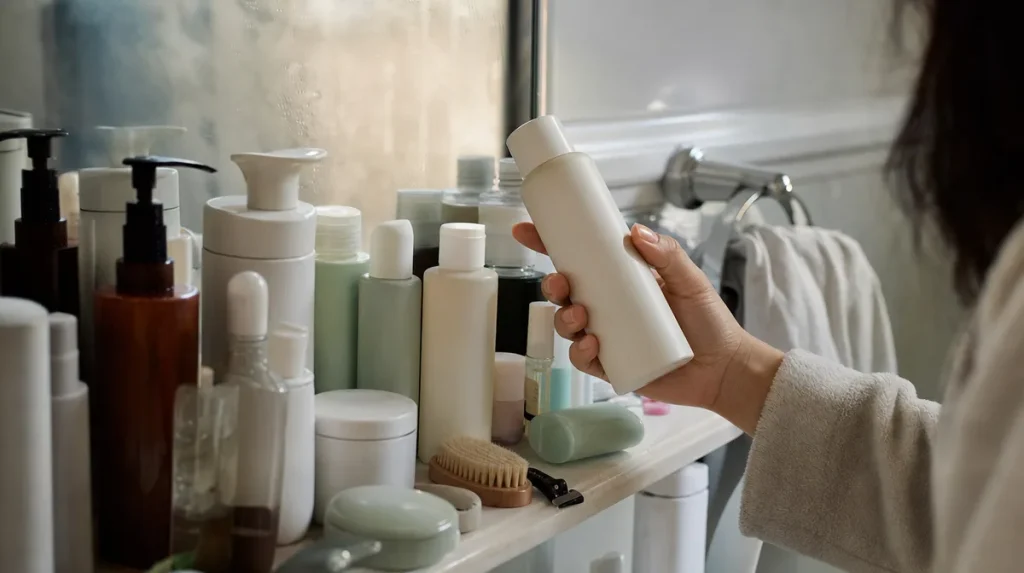
Walk down any supermarket aisle and the bottles compete on the same handful of promises: hydrating, nourishing, spa-like, dermatologically tested. Most of these phrases are not regulated claims, they are marketing language sitting beside an ingredient list that tells the real story.
CHOICE, the Australian consumer group that has lab-tested household products since 1959, has long pointed out that a product’s packaging claims and its actual formulation can pull in different directions. That is not an accusation against any brand, it is simply how cosmetic marketing works everywhere: the label sells a feeling, the ingredient list does the job.
The practical shift is this: stop reading the front of the bottle and start reading the back. The front is advertising copy written by a marketing team. The back is a legal document, in descending order of concentration, and it rewards a slow look far more than a quick sniff in the aisle.
Reading The Ingredient List In Under A Minute
Ingredients are listed by concentration, highest first, down to one percent, after which order becomes less meaningful. In almost every shower gel, water comes first, followed by one or two surfactants, the cleansing agents doing the actual work.
Think of it like a grocery receipt sorted by what filled the trolley most: the bulk items are at the top, the garnish is at the bottom. A wash that lists a plant extract third is using it generously. One that lists the same extract second-to-last is using it for the label, not the skin.
Look for the surfactant family early in the list. Harsher sulfates such as sodium lauryl sulfate clean efficiently but can strip surface lipids with frequent use, something a 2020 study in Skin Research and Technology measured directly in 32 adult participants over two weeks, recording visibly increased water loss from the skin after daily use of a high-sulfate wash compared with a milder formula. Gentler alternatives, often named with amphoacetate or glucoside endings, tend to sit mid-list and clean with less disruption.
Fragrance, listed simply as parfum or fragrance, can appear anywhere and is the most common trigger for irritation in sensitive skin, according to patch-test data referenced by the Australasian College of Dermatologists in its general public guidance on allergic contact dermatitis. If your skin reacts to multiple products and you cannot find a pattern, fragrance is the first ingredient worth removing from the lineup, not the last.
Matching The Wash To What Your Skin Is Doing, Not What Season It Is
Skin type is not fixed. It shifts with weather, hormones, medication, and age, which is why a wash that suited you in January can feel wrong by July.
Dry or flaking skin generally does better with cream-based or oil-infused washes that contain fewer harsh surfactants and more emollients such as glycerin or shea butter. Oily or acne-prone skin can often tolerate, and may benefit from, a slightly stronger clarifying surfactant, though dermatology guidance consistently cautions against over-washing, which can trigger the skin to produce more oil in response to dryness.
Eczema-prone skin needs the gentlest end of the spectrum: low-fragrance, low-sulfate formulas, ideally close to skin’s natural pH. The Australasian College of Dermatologists’ public guidance on eczema management recommends soap-free washes generally, without naming specific products, as a baseline step alongside regular moisturising.
A simple self-test: wash one forearm with your current product, pat dry, and wait fifteen minutes without applying moisturiser. If the skin there feels tight, flaky at the edges, or visibly duller than the rest of your arm, the wash is likely too stripping for that skin right now, regardless of what it did for you last year.
The Lather Myth: What Foam Actually Tells You
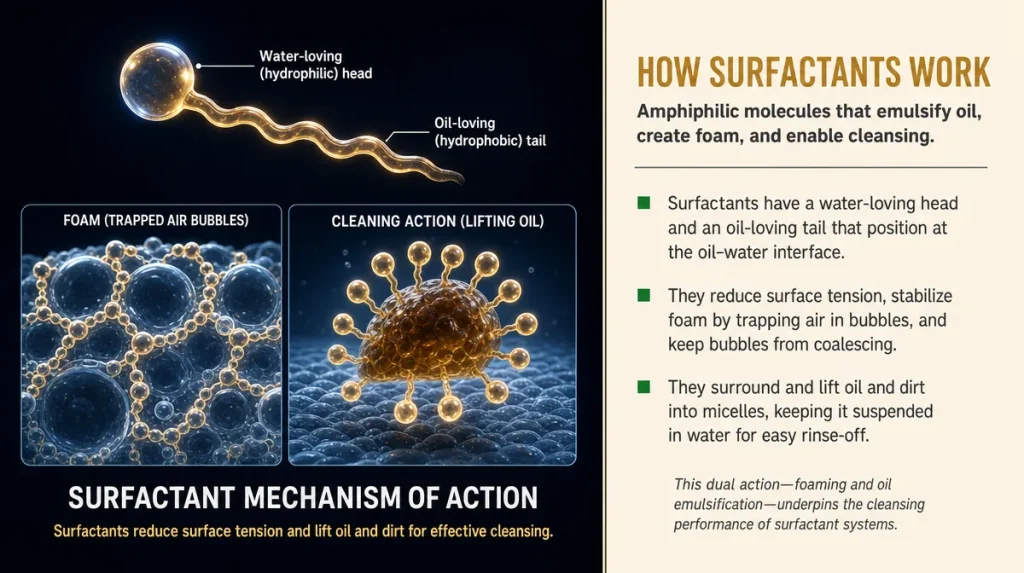
Foam feels like proof of cleaning. It is mostly proof of formulation choices.
Surfactant molecules have a water-loving head and an oil-loving tail, the same basic structure whether you are washing a body or a dinner plate. That structure is what lifts oil and dirt into the rinse water. Foam happens when air gets trapped between those molecules, which is a separate chemical property, often engineered in with specific foam boosters that add bubble volume without adding cleaning power.
This is why a shampoo and a dish detergent can both foam generously while doing very different jobs on very different surfaces. Foam is a texture decision, not a performance measure.
The mistake most people make is assuming low foam means a product is not working, so they use more of it, or scrub harder, or rinse longer, all of which can increase irritation without improving how clean the skin actually gets. A wash that lathers modestly but leaves skin feeling comfortable rather than tight afterwards is very likely doing its job properly.
Water Temperature, Time, And Why Both Can Undo A Good Product
Hot water feels good in a cold climate, but it is doing something specific to the skin’s surface that most people never see.
Skin holds moisture using a layer of lipids between its surface cells, much like grout holds tiles together on a bathroom floor. Hot water is more effective than cool water at dissolving fats, which is exactly why it is better at removing grease from a pan. On skin, that same property strips the protective lipid layer faster, leaving gaps the grout analogy makes easy to picture: the tiles, or skin cells, stay in place, but the seal between them weakens.
A 2017 study in the Journal of Clinical and Aesthetic Dermatology measured transepidermal water loss after showers at three temperatures in 40 volunteers and found measurably higher water loss following hot showers compared with lukewarm ones, with the effect more pronounced after showers longer than ten minutes.
The practical fix costs nothing: lukewarm water, and a shower under ten minutes where possible. Skin barrier health responds to this kind of repeated small choice more than to any single product swapped in or out.
Patching A New Wash Before It Meets Your Whole Body
Switching products cold across your whole body is how most reactions happen, and how people wrongly blame an ingredient that was never the real problem.
The method dermatologists commonly recommend, and that the Australasian College of Dermatologists outlines in its general patch-testing guidance, is straightforward. Apply a small amount of the new wash to a confined area, the inner forearm works well, once daily for three to five consecutive days, without rinsing it into surrounding skin. Watch for redness, itching, or small bumps developing within 48 hours of each application.
If nothing appears after five days, the product is reasonably unlikely to cause a reaction when used more broadly, though results may vary between body areas, since facial and underarm skin tend to be more reactive than skin on the arms or legs.
This step matters most for anyone with a history of eczema, psoriasis, or known fragrance sensitivity, and it is worth repeating for every new formula, not just the ones marketed toward sensitive skin. Sensitive-skin labelling is not independently verified in Australia, so the patch test does the verification a label cannot.
Exfoliating Washes: What The Beads And Acids Can And Cannot Do
Exfoliating body washes, whether they use microbeads, ground particles, or acids such as salicylic or glycolic, work on contact. In a shower, that contact typically lasts somewhere between ten and thirty seconds before the product is rinsed away.
That short window limits what chemical exfoliants can achieve compared with a leave-on product. A 2021 study in the Journal of Cosmetic Dermatology comparing rinse-off and leave-on acid formulations in 36 participants found visibly greater improvement in skin texture from the leave-on version over four weeks, attributing the gap largely to contact time.
That does not make exfoliating washes pointless. Physical particles can help lift flaking skin on rougher areas like elbows and heels, and mild acid washes may offer a gentle maintenance effect for body acne when used two to three times weekly rather than daily.
The mistake to avoid is treating an exfoliating wash as a replacement for a proper leave-on treatment where one is genuinely needed, or using one daily on skin that is already compromised, which can tip gentle exfoliation into irritation.
Judging Results Properly: What Changes In A Week Versus A Month
Expecting a shower gel to transform skin within days sets most people up to quit a perfectly good product too early.
Comfort-level changes, less tightness after drying, calmer reaction to the water, can show up within a week of switching to a gentler formula. Visible changes in overall skin texture or tone generally take longer, since the skin’s surface renews on roughly a four to six week cycle, a timeline widely referenced in dermatology literature on epidermal turnover.
A sensible way to judge a new wash: keep using it consistently for a full four weeks before deciding, barring any signs of irritation, which should prompt stopping immediately. Take a note on your phone each week, two lines on how skin feels after towelling off, rather than relying on memory to compare week one with week four.
If nothing has changed by week four, the wash is probably simply doing a competent, unremarkable job, rather than failing. Not every product needs to produce a dramatic result. Sometimes the correct outcome is simply nothing going wrong.
Key Takeaways
Foam tells you almost nothing about how well a wash cleans or how gentle it is, so stop judging a product by how much it bubbles. Read the ingredient list from the top, where the surfactants and water sit, rather than the claims printed on the front of the bottle. Match the formula to what your skin is doing this month, not what it did last year, and patch test anything new for three to five days before using it everywhere. Keep showers lukewarm and under ten minutes where you can, since heat and time both strip the skin’s protective lipid layer faster than most people realise. Give any new wash a full four weeks before judging it, and treat exfoliating washes as a helpful extra rather than a substitute for a proper leave-on treatment.
A Quick Checklist For Your Next Bottle
- Turn the bottle around before you pick it up: read the first five ingredients, not the front label.
- Check where fragrance sits on the list if your skin has ever reacted to a product before.
- Patch test on your inner forearm for three to five days before using a new wash on your whole body.
- Keep water lukewarm and showers under ten minutes, particularly in winter.
- Save exfoliating washes for two to three uses a week rather than daily, unless your skin tolerates more.
- Give any switch four full weeks, with a short weekly note on how skin feels, before deciding whether it works.
This article is general information only and does not replace personalised advice from a qualified dermatologist or medical practitioner.
Individual skin responses vary, and results described from published studies may not reflect every reader’s experience.