
Chloe Fenwick, Beauty Editor.
You are standing at the bathroom mirror with three half-used bottles of foundation, none of them quite right, and a fourth one you bought last month that oxidised to a strange orange by lunchtime. You type the same question into your phone every few months: what foundation should I actually use. The honest answer has less to do with which bottle you choose and more to do with a handful of habits most people never learn: how to read your own undertone in daylight, how to match finish to what your skin does by 3pm, and how to apply so the product does not sit in fine lines or vanish in patches. This guide walks through those habits in order, with simple self-tests you can do right now, so the next bottle you buy is one you actually finish.
- Daylight, not bathroom light, reveals your true undertone because most indoor globes skew warm or cool and quietly mislead your eye.
- Finish matters more than coverage percentage because a matte formula on dry skin will crack and settle into lines no matter how well it is applied.
- Most foundation failures are application failures, not product failures, so learning three technique fixes solves more problems than switching bottles.
Reading Your Skin Before You Read The Label
Before comparing bottles, most people skip a step: working out what their skin actually does over a normal day, not what it does the moment after cleansing.
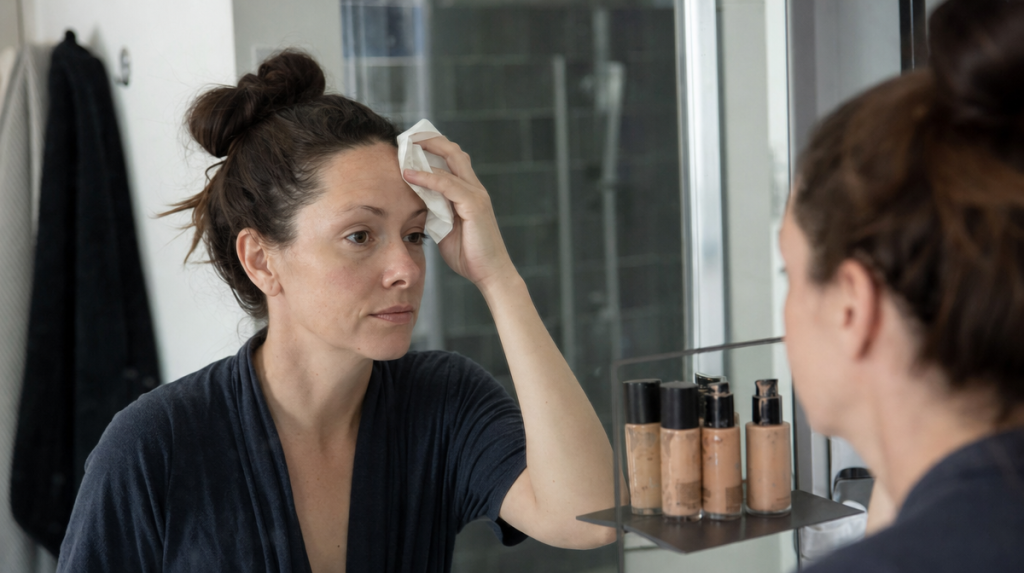
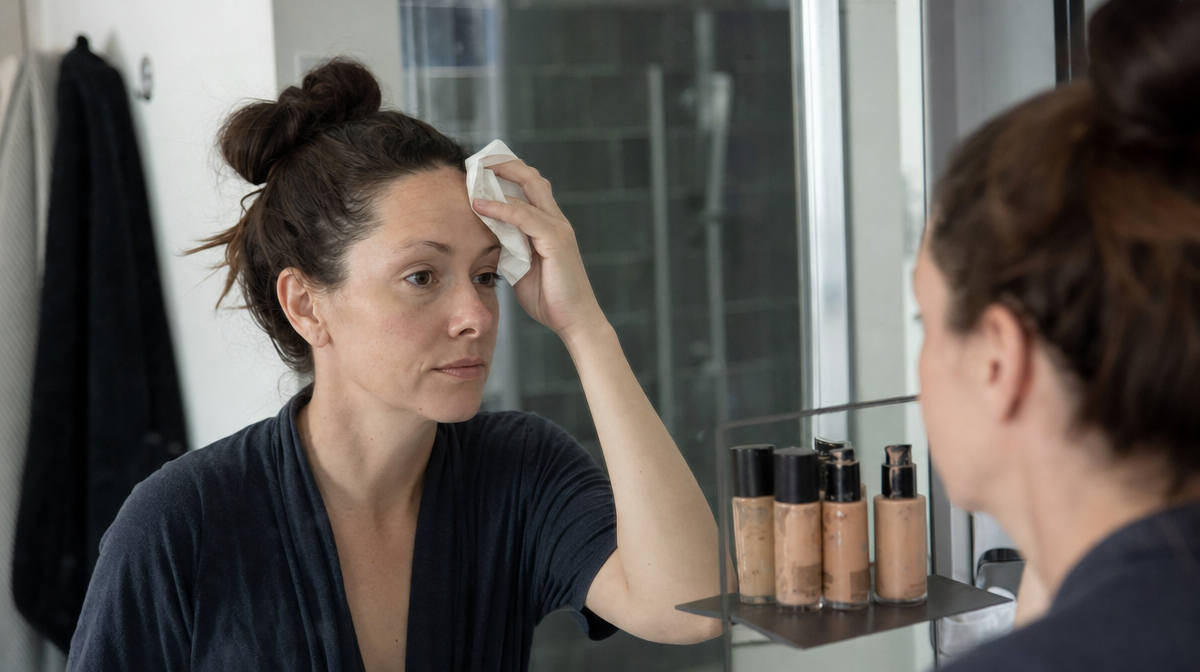
Stand in front of a mirror at midday and blot your forehead and nose with a plain tissue after four or five hours of wear, no fresh product. An oily zone leaves a visible mark. A dry zone feels tight rather than greasy. Combination skin does both, oily in the centre panel, dry at the jaw and cheeks.
This single observation decides more than any shade chart. A dewy or hydrating formula on genuinely oily skin tends to slide by afternoon. A full-matte formula on dry skin can grip onto flaky patches and make them more visible, not less. Think of it the way you would choose paint finish for a room: gloss shows every imperfection on a bumpy wall, while a flat finish hides texture but shows less light. Foundation finish behaves the same way on skin texture.
Once you know your skin’s daily pattern, you are choosing a finish to suit a condition you have actually measured, rather than guessing from a counter recommendation made under shop lighting.
Finding Your Undertone In Daylight
Undertone confusion is the single biggest reason foundation looks wrong along the jawline. It is rarely about being too light or too dark. It is usually the wrong temperature.
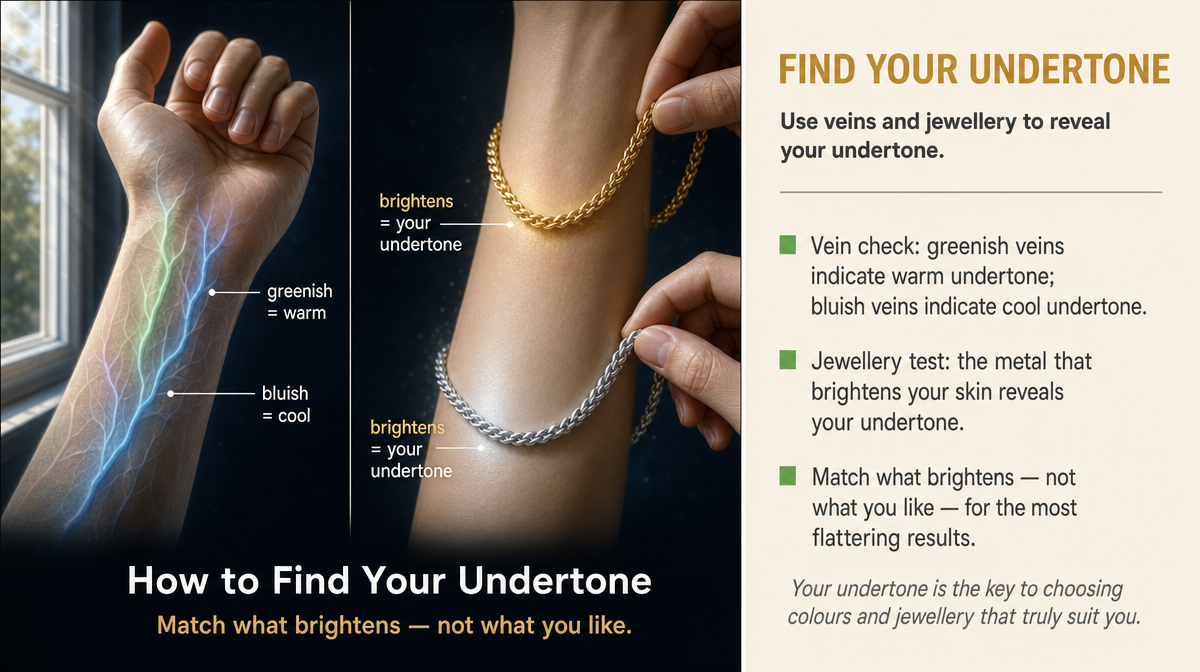
The simplest self-test: step near a window in natural daylight, without makeup, and look at the veins on the inside of your wrist. Green-looking veins generally point to a warm undertone. Blue or purple-looking veins point to cool. If you genuinely cannot tell, you likely sit somewhere neutral, which is common and not a failure of observation.
A second check: hold a piece of plain silver jewellery and a piece of gold jewellery against your inner forearm in the same daylight. Most people find one metal makes their skin look brighter and the other slightly grey. That is your undertone speaking, not a style preference.
The mistake almost everyone makes is testing shades under shop lighting, which is frequently warmed or cooled by LED strips designed to flatter product packaging, not skin. A 2021 study in the Journal of Cosmetic Science found that consumers matched foundation shade correctly far more often under natural daylight than under standard fluorescent retail lighting. If you can, take a small dab of any test product outside for ten seconds before deciding.
Matching Formula To What Your Skin Does, Not What The Label Promises
Foundation packaging leans hard on words like radiant, luminous, velvet and skin-like. These are marketing terms, not technical ones, and they do not tell you how the formula will behave on your particular skin.
What actually matters is a simpler set of properties: oil content, how much the pigment sits on top of skin versus sinking in, and how the formula sets. Dewy and satin finishes generally carry more emollient content, which helps on dry or mature skin but can shift on very oily skin by midday. Matte formulas typically use more powder or silicone-based ingredients to absorb oil, which suits oily skin but can look chalky or emphasise dry patches elsewhere.
A household comparison helps here: think of dewy finish like a lightly oiled cast-iron pan, smooth and reflective, and matte finish like a well-seasoned one, flat and grippy. Neither is better. Each suits a different job.
Coverage level, described as light, medium or full, is really about pigment concentration, not quality. Full coverage is not automatically longer-lasting or more premium, it simply carries more pigment per layer. Many people apply more coverage than their skin needs because they assume full coverage means better result, when a thinner layer, applied well, often looks more natural and wears just as long.
The Application Tools That Change The Result More Than The Product
Two people using the identical bottle can get visibly different results, and the difference usually comes down to tool and technique rather than the formula itself.
A damp makeup sponge, bounced rather than dragged across skin, deposits a thinner and more even layer than fingers, because the sponge absorbs excess product instead of pushing it around. A dense, flat-top brush builds coverage faster and suits fuller coverage needs, but it can leave visible lines if the bristles are too stiff or the product dries before it is blended.
Fingers work better than most people expect for a light, natural finish, because body heat helps the product melt into skin, though they deposit less even coverage across large areas like the forehead.
The mistake almost everyone makes is applying foundation in downward strokes only. Facial hair, however fine, generally grows outward and slightly downward on most people, and product dragged in one direction tends to sit unevenly around the nose and chin. Blending in small circular motions, working outward from the centre of the face, tends to leave a more even film.
A quick self-test: apply foundation to one half of your face with your usual method, then apply the other half using a bounced damp sponge and small circular motions. Photograph both sides in daylight. The difference is often larger than people expect.
Why Foundation Changes Colour After A Few Hours
Oxidation is the technical name for the colour shift many people notice an hour or two after application, usually a foundation turning slightly orange or grey compared with how it looked fresh from the bottle.
This happens because some pigments react with oxygen and with the natural oils on skin over time. Oilier skin oxidises formulas faster and more visibly, because there is more oil available to react with. This is a chemical property of certain pigments, not a fault with your skin or a sign the product has gone off.
The practical fix is testing shade at the very light end of what you think you need, since the colour will typically deepen slightly as it sits. Testing on the jawline rather than the back of the hand also matters, because hand skin has a different oil level and does not oxidise the same way facial skin does.
A short self-test: apply a small amount along the jawline in the morning and check it again at midday without reapplying anything. If it has shifted noticeably warmer or darker, that shade will likely always run slightly light on you in the bottle and slightly deeper by afternoon, which is useful information for future purchases regardless of which product you eventually choose.
What Realistic Wear And Coverage Actually Look Like
Marketing language around foundation often promises coverage that lasts a full day without any touch-up, in a single thin layer. For most skin types, this is not a realistic standard to judge against.
Oily skin typically needs a light touch-up by early afternoon around the T-zone regardless of formula, simply because sebum production continues throughout the day. Dry skin may show foundation settling into fine lines by evening, particularly around the eyes, which is more about hydration levels underneath the makeup than the foundation itself.
A fairer way to judge a foundation is not whether it survives eight hours untouched, but whether it survives a normal working day with one light blot or one small touch-up, and whether it comes off cleanly at the end of the day without staining a cleansing cloth in a way that suggests heavy build-up.
Colour matching should also be judged after wear, not immediately after application. Give any new foundation at least two full wears in daylight, ideally on days with different weather, before deciding whether the shade genuinely works. A single test in a shop mirror rarely tells you enough.
Skin Preparation, Patch Testing And Where The Real Risk Sits
Foundation performance depends heavily on what sits underneath it. Skin that is under-moisturised will often make even a well-matched foundation look patchy or accentuate dry flakes, regardless of formula quality.
A simple, unglamorous routine tends to outperform an elaborate one: cleanse, apply a moisturiser suited to your skin type, wait a few minutes for it to absorb, then apply sunscreen if you are heading outdoors, and only then apply foundation. Applying foundation directly over unabsorbed moisturiser is one of the more common causes of a product sliding or pilling within an hour.
On sun protection specifically, Cancer Council guidance is clear that foundation containing SPF should not be relied on as a person’s sole source of sun protection, because the amount most people apply falls well short of the amount used in laboratory SPF testing. A dedicated, adequately applied sunscreen underneath remains the more reliable approach on any day with meaningful UV exposure.
For anyone with sensitive skin or a history of reactions, the Australasian College of Dermatologists’ general public guidance recommends patch testing any new cosmetic product on a small area of skin, such as the inner forearm, for 48 hours before applying it to the face. This is a small habit that prevents a genuinely unpleasant surprise.
What Matters Versus What Is Marketing Noise
A useful habit when reading any foundation label is separating claims that describe a measurable property from claims that describe a feeling.
Words like matte, dewy, medium coverage, oil-free and long-wear generally describe something you can test and verify yourself within a day. Words like luxurious, skin-loving, radiant glow or transformative describe an intended feeling and cannot be checked against anything measurable.
Ingredient lists matter more than the front-of-bottle language, but only for a short list of properties: whether an oil-free formula genuinely lists silicones or other mattifying agents near the top, and whether a hydrating claim is backed by humectant ingredients such as glycerin or hyaluronic acid appearing early in the list rather than near the bottom, where concentration is typically lowest.
CHOICE has previously tested cosmetic and skincare claims against ingredient panels and found that front-of-pack language frequently overstates what a formula’s actual ingredient concentration can support. That kind of independent scrutiny is worth remembering next time a bottle promises more than a label’s fine print can reasonably back up.
Key Takeaways
Foundation success has less to do with finding a miracle bottle and more to do with three habits: matching undertone under real daylight, matching finish to what your skin actually does across a day rather than what feels aspirational, and applying with a technique suited to the coverage you want. Most disappointing results trace back to one of these three, not to the product itself.
A Simple Checklist Before You Buy Or Reapply
- Blot your skin at midday to confirm oily, dry or combination pattern before choosing a finish.
- Check undertone against jewellery or wrist veins in daylight, never under shop lighting alone.
- Test any new shade on the jawline, not the hand, and check it again after a few hours for oxidation.
- Apply moisturiser and let it absorb fully before foundation to avoid sliding or pilling.
- Use sunscreen underneath rather than relying on SPF listed on a foundation label.
- Patch test new products for 48 hours if your skin reacts easily.
- Judge any new foundation over two full wears in daylight before deciding it does not suit you.
This article is general information only and does not replace individual advice from a qualified dermatologist or health professional.
Individual results vary depending on skin type, environment and application technique.